.png)


Oct. 21, 1pm EST
Description:
Reaching professionals in the concrete construction industry takes more than a strong headline and a well-designed email. Marketers, associations and industry organizations that rely on generic messaging or outdated assumptions often find their communications ignored, their programs underattended and their engagement metrics stalled. The concrete construction audience has distinct motivators, professional identities, and decision-making patterns that differ meaningfully from broader A/E/C segments, and understanding those differences is what separates effective outreach from wasted effort.
This session draws on AOE's decades of direct experience supporting associations, firms, and organizations in the concrete, building, and design industries to offer a grounded, practical picture of this audience. Presenters share observed patterns in how concrete construction professionals consume information, respond to messaging, engage with associations, and make decisions about products, training, and industry participation. Attendees will learn how to apply those insights to strengthen their marketing, communications, member programming, and engagement strategies in ways that reflect how this audience actually thinks and behaves.
Learning objectives:
-
Recognize the defining characteristics, professional motivations, and communication preferences of the concrete construction audience based on observed industry behavior.
-
Identify where generic messaging strategies fall short for this audience and how to adjust positioning and tone for greater relevance.
-
Apply audience insight to improve the targeting, content, and delivery of marketing campaigns, member programming, or stakeholder communications.
-
Develop a more informed engagement strategy that reflects the priorities and decision-making patterns of concrete construction professionals.
Speaker:
Drew Burns is Director of Client Strategy at AOE (Advancing Organizational Excellence), bringing more than 15 years of expertise in strategic planning, communications, marketing and operations management for trade associations and industry organizations. A Certified Association Executive since 2020, Drew actively works with organizations in the architecture, engineering and construction industries to drive sustainable growth and long-term success. Drew has worked with organizations including the Slag Cement Association and the Great Lakes Cement Promotion Council, and he currently helps coordinate operations for the American Concrete Pavement Association Foundation. He has a proven ability to partner with boards of directors to elevate their brands and advance their missions. His work spans building strategic initiatives, planning events and delivering results-driven marketing campaigns. He specializes in developing compelling narratives, creating visually captivating designs and aligning organizational goals with actionable strategies.

Nov. 4, 1pm EST
Description:
Artificial intelligence has moved from emerging technology to operational standard across technical industries, yet most organizations are not extracting its full value. The pressure to adopt AI is intense, but widespread adoption has produced a misleading picture of readiness. Organizations that treat AI as a basic writing assistant or simple search utility rather than a strategic collaborator are leaving their most significant opportunities unrealized. This session addresses that gap directly, presenting a field-tested framework drawn from AOE's experience supporting technical industry organizations through the complexities of AI integration. Attendees will explore how to shift from surface-level adoption to habit-driven, high-value use by establishing role-specific best practices, building standardized prompt workflows and governed content pipelines, integrating legal and compliance constraints early in the process, creating internal knowledge-sharing networks and investing in upskilling that builds critical thinking alongside technical proficiency.
Learning objectives:
-
Diagnose the gap between surface-level AI adoption and meaningful integration, identifying the behaviors and habits that separate basic usage from high-value, performance-driven outcomes in technical industries.
-
Apply a structured framework for building role-specific AI best practices, including standardized prompt workflows, governed content pipelines and compliance protocols that reduce risk and improve output quality.
-
Develop an organizational approach to AI literacy and knowledge sharing by establishing upskilling programs, internal mentorship structures and cross-functional governance practices that build sustained competence.
-
Connect AI implementation decisions to measurable business outcomes by evaluating cybersecurity risks, monitoring unauthorized tool use and aligning AI investments with performance metrics that demonstrate concrete organizational impact.
Speakers:
Emily Emanuelsen is the Publications Manager and AI Practice Group Leader at AOE. In this capacity, she leads AOE’s efforts to stay on top of emerging AI trends and topics and its applications throughout the AEC industry. Emily oversees the development of journals, magazines, and digital products for many of AOE’s clients. She has also created various resources on AI and publication management, including blogs, recordings, checklists, live trainings, and one-pagers, as well as a system for performing website audits with regard to SEO, GEO, and AEO.
Emily holds a Bachelors of Arts in English and Economics from George Fox University and a Masters of Fine Arts in Writing from Pacific University. In her free time, Emily likes to write fiction, garden and play piano.
Laura Merritt brings a wealth of experience in public relations, crisis communications and artificial intelligence optimization to the AOE team. With more than 25 years of experience as a trusted communications professional and experienced storyteller for a Fortune 50 company, Laura lends her skills to AOE as a senior account manager, helping clients reach their target audiences through strategic messaging in marketing, public relations and social media. Her expertise also includes artificial intelligence (AI) optimization, crisis communications and supporting and/or leading campaigns ranging from product launches to company rebranding. Laura also holds a certification in Marketing for AI.

Dec. 2, 1pm EST
Description:
Effective governance is one of the most powerful drivers of association performance, yet it is also one of the most commonly mismanaged. Boards struggle with unclear roles and responsibilities, inconsistent policy application, slow or fragmented decision-making and a persistent disconnect between governance activity and organizational strategy. When these challenges go unaddressed, they create friction at the leadership level that ripples through staff operations, member experience, and long-term mission delivery.
This session draws on AOE's decades of hands-on experience in association management, board relations, strategic planning, and organizational effectiveness to offer a field-tested perspective on what strong governance actually looks like in practice. Attendees will explore the structural and behavioral factors that distinguish high-performing boards from those that stall progress, and will leave with practical tools for clarifying roles, strengthening decision-making processes and aligning board activity with the strategic direction of the organization.
Designed for association executives, board members and governance committee leaders, this session delivers actionable guidance that attendees can apply immediately to improve board performance and organizational outcomes.
Learning objectives:
-
Identify the most common governance gaps facing associations, including role ambiguity, policy inconsistency, and misalignment between board priorities and organizational strategy.
-
Apply proven frameworks for clarifying board and staff roles, establishing consistent governance practices, and improving decision-making effectiveness.
-
Develop strategies for strengthening the working relationship between board leadership and executive staff to support more cohesive, mission-driven governance.
-
Assess your organization's current governance structure against established best practices and identify priority areas for improvement.
Speaker:
Bryce Barker is tasked with the management and oversight of AOE’s association management portfolio. She is responsible for the project management and operations of this line of business and also serves as the liaison between AOE and the association staff/board members. A key element of her role is the development and application of association best practices. Building on a long tenure in project management and event planning, she holds a bachelor’s degree in Tourism, Hospitality and Event Management from Indiana University. Bryce also has her Certified Meeting Professional (CMP) credential from the Events Industry Council.
Previously Recorded Webinars
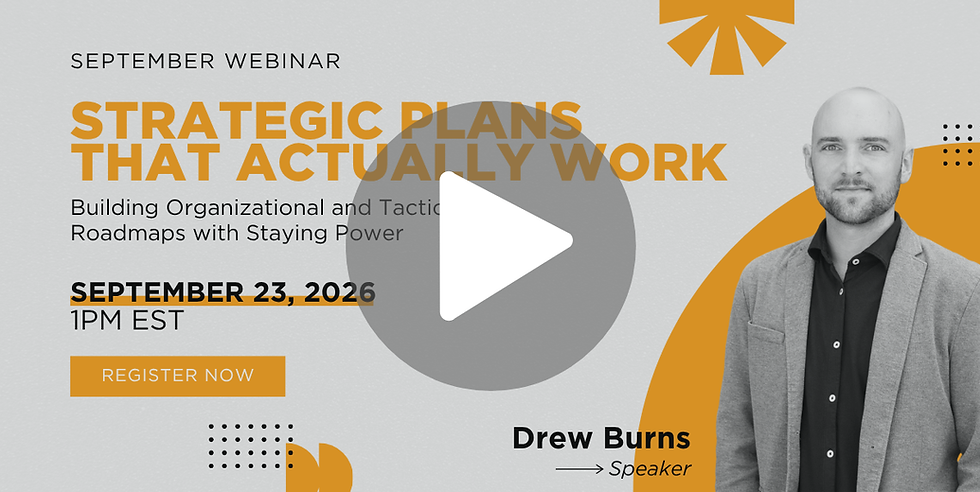
Strategic plans that actually work: Building organizational and tactical roadmaps with staying power
Description:
Many organizations have been through a strategic planning process. They have gathered stakeholders, built consensus and produced a polished document. Then, six months later, the plan sits untouched while day-to-day demands take over. The problem is rarely a lack of ambition. It is a lack of structure, ownership and connection to operational reality. This session cuts through the noise to show you how to build strategic plans that move from paper to practice. Drawing on AOE's deep experience in strategic planning, association management, and member engagement, we walk through a proven framework for developing organizational or tactical plans that align with your mission, reflect stakeholder priorities, and translate directly into accountable action. You will learn how to set measurable goals, assign clear ownership, and build in the review checkpoints that keep momentum alive long after the planning retreat ends.
Whether you are refreshing a long-term organizational strategy or building a focused tactical plan for a specific initiative, this session gives you practical tools to make your next plan one your team will actually use.
Learning objectives:
-
Identify the most common reasons strategic plans fail to drive action and how to address them before the planning process begins.
-
Apply a structured framework for developing organizational or tactical plans that connect mission, priorities, and measurable outcomes.
-
Build stakeholder alignment and clear ownership into your planning process to sustain accountability beyond the initial launch.
-
Establish review and adjustment mechanisms that keep your plan responsive to changing member needs and market conditions.
Speaker:
Drew Burns is Director of Client Strategy at AOE (Advancing Organizational Excellence), bringing more than 15 years of expertise in strategic planning, communications, marketing and operations management for trade associations and industry organizations. A Certified Association Executive since 2020, Drew actively works with organizations in the architecture, engineering and construction industries to drive sustainable growth and long-term success. Drew has worked with organizations including the Slag Cement Association and the Great Lakes Cement Promotion Council, and he currently helps coordinate operations for the American Concrete Pavement Association Foundation. He has a proven ability to partner with boards of directors to elevate their brands and advance their missions. His work spans building strategic initiatives, planning events and delivering results-driven marketing campaigns. He specializes in developing compelling narratives, creating visually captivating designs and aligning organizational goals with actionable strategies.